On Demand vs Bulk Merch: What Wins?
A merch drop can look strong on the timeline and still flop in the warehouse. That’s the real tension in on demand vs bulk merch. One model keeps you light, fast, and flexible. The other can raise margins and control, but only if your audience is locked in and your numbers are real.
For Web3 brands, NFT communities, and digital creators, this choice is not just operational. It shapes how you launch, how exclusive your products feel, how much cash you tie up, and how quickly you can turn online identity into something people actually wear. If your brand lives on hype cycles, holder perks, artist collabs, and limited drops, the wrong merch model can kill momentum fast.
On demand vs bulk merch: the real difference
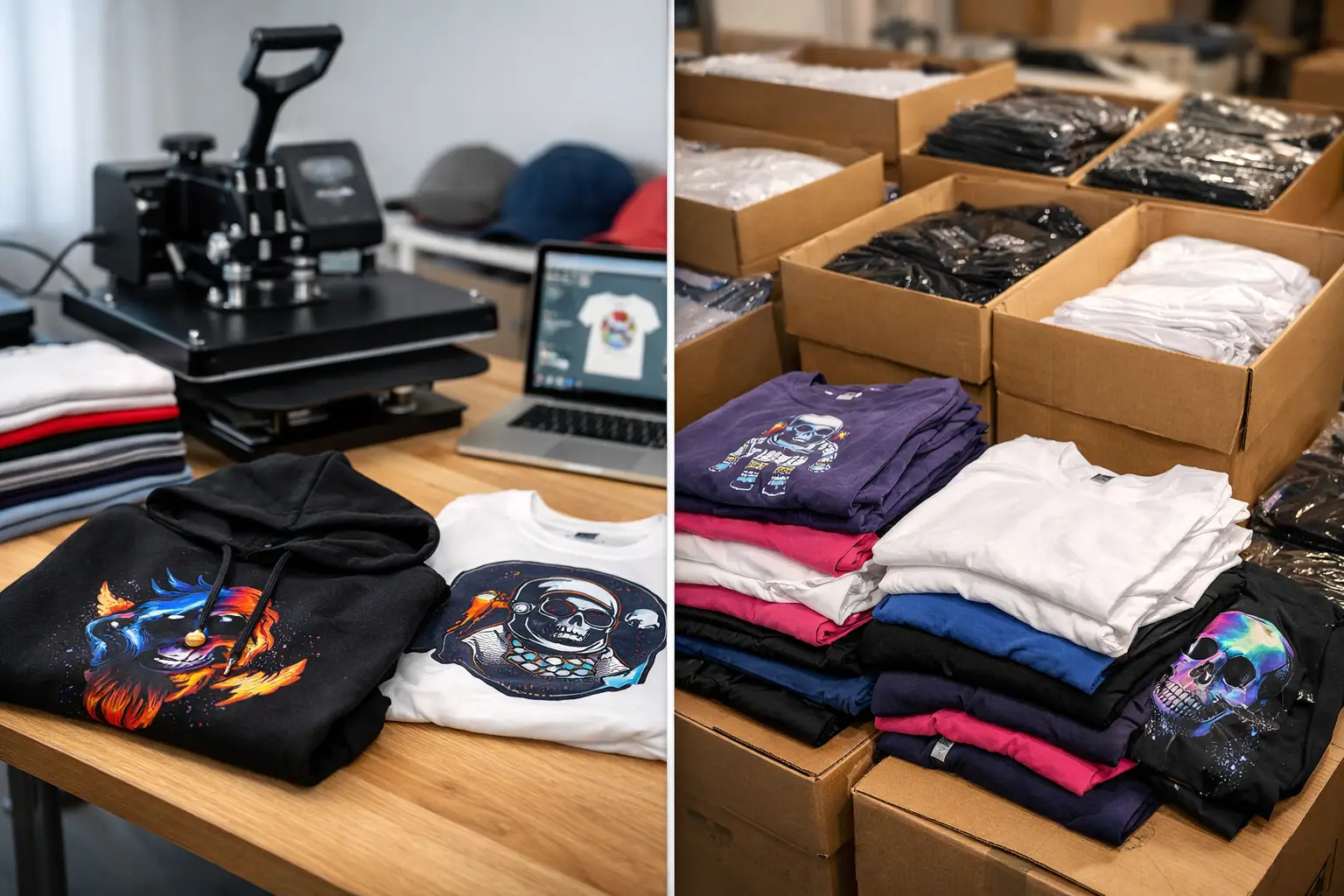
On-demand merch is produced after the order is placed. You sell first, then the item gets made and shipped. Bulk merch flips that. You commit to inventory upfront, produce a set quantity, store it, and fulfill from stock.
That sounds simple, but the trade-off runs deeper than production timing. On demand protects you from dead inventory and lets you test designs with almost no minimum commitment. Bulk gives you more control over materials, packaging, finishing details, and unit economics, but it also asks you to bet on demand before demand is proven.
For a Web3 brand, that difference matters. Communities move fast. Attention spikes around mints, reveals, partnerships, Twitter moments, Discord activity, and market sentiment. A design that feels hot this week can feel dated next month. On demand works with that rhythm. Bulk works best when your demand is stable enough to justify the risk.
When on-demand merch makes more sense
If you are building around drops, community identity, and constant creative rotation, on demand is usually the cleaner play. It lets you launch without sitting on boxes of unsold tees when the narrative changes.
This is especially useful for NFT projects and digital artists testing what their audience actually wants to wear. Not every great piece of art becomes a great hoodie. Not every loud graphic belongs on a hat. On-demand production lets you validate the design in the market instead of guessing in advance.
There is also a branding advantage that gets overlooked. In Web3, relevance matters. Communities want merch that feels connected to a moment, not leftovers from six months ago. On demand supports quick reactions to culture. A new character trait, meme, collab, or holder inside joke can become a product without a huge production lead.
Then there’s access. Smaller communities, niche subcultures, and emerging creators do not always have the volume to justify bulk runs. On demand removes the gatekeeping. You do not need to be a giant brand to put out polished merch. You just need a real audience and a design worth wearing.
That is a big part of why the model fits streetwear-minded Web3 commerce so well. It keeps your catalog open, your risk lower, and your creative options wide.
Where bulk merch still has the edge
Bulk is not old-school for the sake of it. In the right situation, it is a power move.
If you know a design will move at volume, bulk can improve your margins. Unit costs usually come down when you order larger quantities. That can create more room for premium packaging, better blanks, custom finishing, or stronger profit per piece.
Bulk also gives you tighter control over the product. If you want heavyweight custom-cut hoodies, sewn labels, special washes, embroidery placement, or detailed branded packaging, bulk may be the better route. It is often the model behind highly engineered fashion drops where every physical detail is part of the statement.
Speed after purchase can be another advantage. Because the items are already made, fulfillment can be faster. That matters if your audience expects a quick turnaround or if you are selling around a time-sensitive event.
But here is the catch. Bulk only wins when you can predict demand with some confidence. If your community says they want merch but does not convert, you are left holding inventory that ties up cash and clogs your operation. In Web3, where sentiment can flip overnight, that is not a small risk.
Cost is not just about price per unit
A lot of brands compare on demand vs bulk merch by looking only at unit cost. That is too shallow.
Yes, bulk usually looks cheaper per item on paper. But that number ignores storage, fulfillment overhead, unsold inventory, markdowns, and the cost of being wrong. A cheap unit price becomes expensive fast when half the run sits untouched.
On demand often carries a higher per-piece production cost, but it dramatically lowers inventory risk. You pay for what sells. That changes the financial picture, especially for brands with unpredictable demand or broad product experimentation.
For Web3-native sellers, the smart question is not “Which model is cheaper?” It is “Which model protects margin without killing flexibility?” Those are different questions.
If your project has one hero design with repeat demand, bulk may deliver better economics. If you are running multiple designs, artist collabs, holder-only concepts, or seasonal capsules, on demand can actually be the more efficient model once you factor in waste and missed forecasts.
Brand experience matters more than people think
Merch is not just product. It is proof of belonging.
That changes how you should think about fulfillment. If your audience is buying to signal identity, the design has to hit, but the buying experience also has to feel legit. Quality, print clarity, fit, and consistency matter. So do product pages, checkout trust, and reliable delivery windows.
Bulk can support a more customized unboxing experience if you have the resources. On demand can still deliver a premium feel, but it depends on the production partner, garment selection, and print standards. The model itself is not premium or cheap. Execution is.
For a brand like NFT Merch, produced on demand and built around authentic Web3 collaborations, the value is not in pretending to be a traditional wholesaler. It is in making culture wearable without forcing brands or buyers into rigid inventory bets. That keeps the focus where it belongs – on relevance, design, and community connection.
Which model fits different stages of growth?
Early-stage creators and NFT communities usually benefit more from on demand. At that stage, your biggest advantage is speed and experimentation. You are still learning what your audience responds to, which products convert, and what kind of visual language they actually want in real life.
Mid-stage brands can go either way. If you have sales data, repeat buyers, and clear bestsellers, selective bulk ordering may start to make sense for core products. That does not mean abandoning on demand. A hybrid model can work well, where proven staples are stocked in bulk and new or niche designs remain on demand.
Established brands with predictable demand, event schedules, and stronger operational infrastructure may get more from bulk for flagship drops. Even then, on demand still has a role. It is useful for long-tail products, global catalog expansion, and lower-risk testing before a bigger commitment.
So the answer is not always one or the other. It depends on how stable your demand is, how much cash you can put at risk, and how central merch is to your brand business.
How Web3 brands should decide
If your merch strategy is built around exclusivity, fast-moving design, and community-led culture, on demand usually gives you the sharper setup. It keeps you responsive. It avoids inventory drag. It lets you launch more ideas without overcommitting.
If your strategy is built around scale, tightly controlled product design, and proven repeat demand, bulk can give you stronger margins and more physical brand control. But it asks for confidence, discipline, and operational maturity.
The smartest move is to be honest about your stage. Too many brands choose bulk because it feels more official. Too many others default to on demand without thinking about where custom product details could elevate the brand. The right answer is the one that matches your audience behavior, not your ego.
In Web3, culture moves faster than inventory. Choose the merch model that lets your brand stay wearable, credible, and ready when the next moment hits.