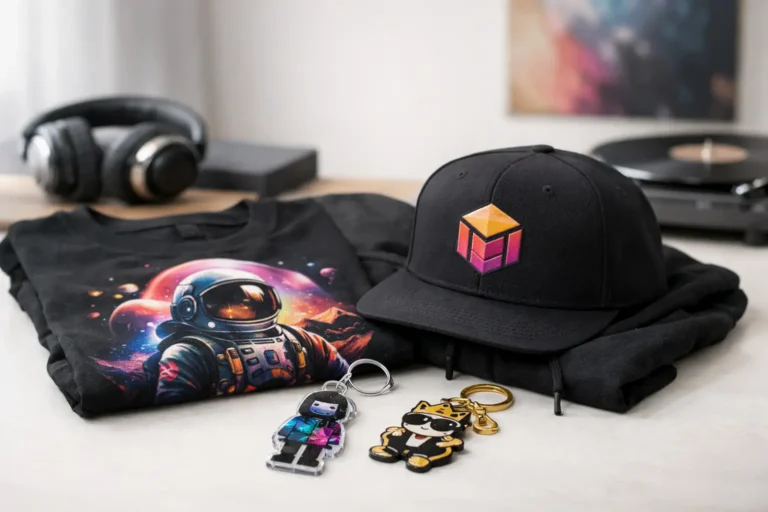
Limited Edition Web3 Products That Matter
A wallet can prove what you hold. Your fit can show what you stand for. That is the real pull of limited edition web3 products: they take the culture living in your PFP, Discord, collector wallet, and favorite artist drop and put it into the physical world.
A hoodie is not automatically a collectible because it has a blockchain reference on it. A cap does not become meaningful because the word “crypto” is printed across the front. The pieces people keep, wear out, photograph, and talk about are tied to a real community, a sharp creative point of view, and a release moment worth remembering.
For Web3 communities, physical merch is no longer an afterthought. It is a signal. It says you were there, you get the reference, and you are part of something that exists beyond the feed.
Why limited edition Web3 products hit differently
Digital ownership made scarcity legible to a generation that grew up online. Collectors understand editions, traits, provenance, mint dates, and the difference between being early and simply showing up later. Physical products can carry that same energy, but only when the drop has an authentic reason to exist.
The strongest releases are built around a recognizable visual language. Think original character art, a community in-joke, a specific collection era, or a collaboration between a Web3 artist and a brand that understands streetwear. The item becomes a piece of cultural memory rather than generic logo merch.
That matters because fashion is social proof. A well-designed sweatshirt inspired by a respected NFT project can start a conversation at an event, on the street, or in a creator’s video. It gives a holder a way to represent their digital identity without explaining their entire wallet to strangers.
There is also a difference between limited and inaccessible. A smart drop can feel special without turning every product into a high-pressure resale game. Exclusivity should reward the culture, not punish the people who genuinely want to wear it.
Scarcity needs a story, not just a number
“Only 100 made” is not a strategy by itself. If the artwork is forgettable, the partnership feels random, or the product quality is weak, a low number will not create lasting demand. Artificial scarcity fades fast. Cultural relevance sticks.
A meaningful limited release usually has three things working together: a defined creative concept, a clear release boundary, and a product people would want even without speculation. That boundary might be a one-week drop window, a capsule tied to an artist release, a holder-focused colorway, or a design that will not return once the collection closes.
On-demand production can fit this model well. The limitation does not have to be a warehouse count. It can be the moment. When a design is available only during a set collaboration window, buyers know the piece belongs to that chapter of the community. Producing to demand also avoids stacks of unsold merch headed for landfill, which is a better look for any brand building for the long term.
The trade-off is transparency. If a product is presented as limited, the rules need to be clear. Is the artwork retired after the drop? Is the colorway exclusive? Can the design return on a different garment? Collectors respect a brand that states the terms and stands behind them.
The product still has to earn a place in your rotation
Web3 people have seen enough rushed merch to spot it instantly. A tiny logo slapped on a thin blank is not a flex. If the goal is to bring digital art into real life, the physical execution needs to hold up.
Start with the garment and the use case. Heavyweight hoodies, washed tees, clean embroidery, oversized fits, and considered graphics make sense when the audience wants streetwear that can live beyond a conference weekend. A bold all-over print may work for a beach towel, swimwear, or a collectible poster, while a subtle chest mark can make a cap or bag easier to wear daily.
The best product mix also gives community members more than one way in. Not everyone wants a full graphic hoodie. Some collectors want a patch for a jacket, a mug for their desk, a sticker pack for their laptop, or a poster that turns a home office into a personal gallery. Identity can be loud or low-key. Both count.
This is where curated Web3 merch has an edge over generic print-on-demand catalogs. The goal is not to place an image on every possible object. It is to choose products that make the art, the community, and the buyer look good together.
Authenticity is the real status signal
Web3 culture moves quickly, but the audience has a sharp radar for forced relevance. A project name alone is not enough. Buyers want to know that the art is authorized, the collaboration is real, and the people behind the drop understand the community they are speaking to.
Authenticity shows up in the details: recognizable creative direction, accurate references, proper artist credit, and products that feel connected to the project instead of borrowed from it. It also shows up in how a brand talks about ownership. Not every physical item needs an NFT attached to it, and not every purchase needs a complicated wallet flow. Sometimes the value is simple: official art, a limited run, and a piece you are proud to wear.
NFT Merch approaches this space as a destination for official, design-led physical goods from recognizable NFT brands and Web3 artists. That distinction matters. A community’s visual world has value, and it deserves more care than unofficial copies and low-effort crypto graphics.
How to spot a drop worth owning
Before you buy, look past the countdown timer. Ask whether the piece represents a community or artist you would still want to support after the hype cycle moves on. Check the artwork closely. Is it distinct, intentional, and true to the original visual world?
Then consider how it fits your life. A collectible that stays sealed in a drawer can be valid, but wearability gives physical merch a different kind of value. The right item becomes part of your everyday rotation, your travel fit, your event look, or the background of the content you create.
It also helps to understand the release terms. A short sale window and a retired design create a different kind of scarcity than a numbered edition. Neither is automatically better. A numbered run may appeal to collectors who value a fixed supply, while a time-boxed release can let more real supporters participate without overproducing inventory.
Finally, buy for connection, not a promised flip. Some limited products may become hard to find later, but resale value is never guaranteed. The best reason to own the piece is that it means something now.
Physical culture is part of the Web3 stack
The old line between online identity and offline life is getting thinner. Communities form digitally, artists build global audiences from a screen, and collectors establish taste through the projects they choose to back. Physical products give all of that texture.
A limited tee can mark a mint anniversary. A tote can carry an artist’s work into daily life. A blanket, poster, or pair of shorts can turn a digital collection into something you can actually live with. These are not replacements for the token, the art, or the community. They are extensions of them.
That is why the next generation of Web3 merch should feel less like promotional swag and more like product design with a point of view. Make the release specific. Respect the art. Set clear terms. Choose pieces that deserve to be worn.
When a drop gets those details right, it does more than sell a product. It gives the community a way to carry its culture everywhere it goes.